
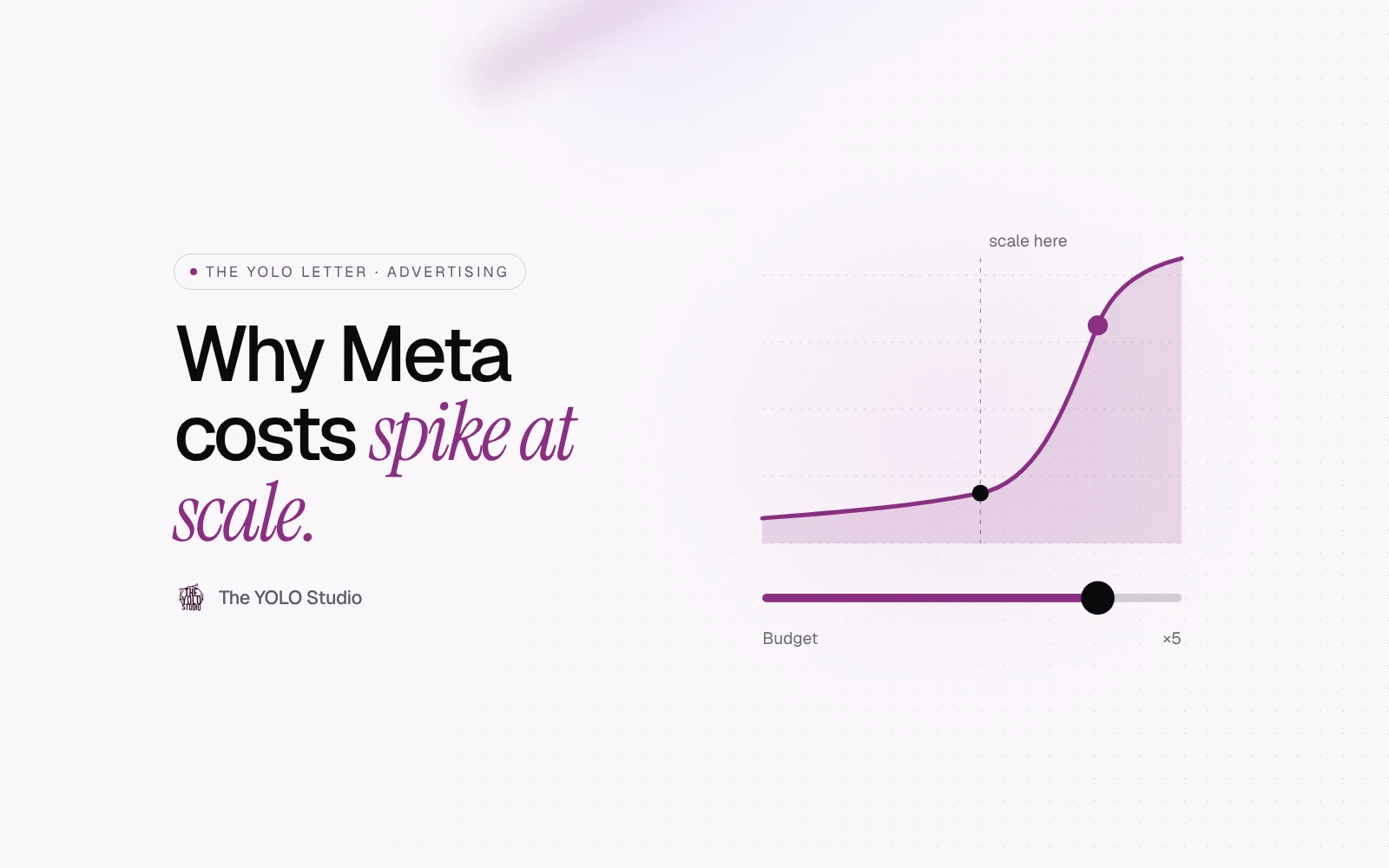
It is one of the most frustrating moments in paid advertising. A campaign is working at a small daily budget. Orders are coming in at a cost you are happy with. So you double the budget, or triple it, expecting double or triple the results.
Instead, your cost per purchase jumps. Results grow a little, but spend grows a lot. A few days later you are wondering whether the campaign was ever really working.
This is normal. It does not mean Meta is cheating you, and it does not always mean the campaign is broken. It means you have run into the way Meta's delivery system and the auction actually work. Once you understand why costs rise, you can scale in a way that keeps them under control.
Why costs rise when you scale
1. You move past your cheapest customers
At a small budget, Meta shows your ads to the people it thinks are most likely to act. These are your easiest, cheapest conversions. When you increase the budget, Meta has to reach further, into people who are less likely to buy or who need more persuading. Each extra sale costs a bit more than the last.
This is called diminishing returns, and it applies to every ad account. The question is not whether costs will rise as you scale, but how fast.
2. Big budget jumps reset learning
Meta's delivery system needs data to optimise. When you make a significant change to an ad set, such as a large budget increase or a new audience or creative, it often goes back into a learning phase. During learning, delivery is less stable and costs are usually higher while the system explores again.
Many advertisers make this worse by changing several things at once, then changing them again two days later before the system has settled.
3. Your audience is smaller than it looks
In a market like Bangladesh, a tightly targeted audience can be exhausted quickly. If you are selling a premium product in one city to a narrow age and interest group, there may simply not be enough new people to absorb a larger budget. Meta then shows the same ads to the same people more often.
4. Frequency rises and creative wears out
When the same person sees the same ad again and again, they stop noticing it. Click-through rates fall, the cost of each result rises, and comments may even turn negative. Creative fatigue is one of the most common reasons a winning campaign slowly becomes a losing one.
5. Competition changes around you
You are bidding in an auction against every other advertiser trying to reach the same people. Costs often rise during busy seasons such as Eid, Pohela Boishakh, Black Friday or the end of the month, when many brands push budget at the same time. A cost increase is not always about your account.
How to scale without burning money
Scale gradually
Instead of doubling a budget overnight, increase it in smaller steps and give each step a few days to stabilise before the next one. Slower scaling usually keeps delivery steadier and avoids repeatedly pushing the ad set back into learning.
Scale horizontally, not only vertically
Vertical scaling means putting more money into the same ad set. Horizontal scaling means expanding what you are doing: new audiences, new placements, new creative angles or new offers. Combining both gives Meta more room to find buyers rather than squeezing a single audience harder.
Give the algorithm room
Broad targeting, with good creative and a clear conversion event, often scales better than a stack of narrow interest audiences. Advantage+ campaigns and broader audiences let Meta look for buyers where they actually are, as long as your pixel and conversion data are reliable.
Treat creative as your main lever
At scale, creative does most of the targeting work. Plan to launch new ads regularly, not only when performance collapses. Test different hooks, formats and messages: a short video, a customer review, a product demo, a founder talking to camera. Keep the ones that work and retire the ones that fade.
Watch the right numbers
- Frequency: if it keeps climbing while results fall, your audience or creative is tired.
- Click-through rate: a falling CTR is often the first sign of creative fatigue.
- Cost per result over several days: do not react to a single bad day. Look at trends.
- Real business results: compare ad-reported sales with actual orders, deliveries and returns. In cash-on-delivery markets, a purchase in Ads Manager is not always money in the bank.
Fix the website before adding budget
If your landing page is slow, confusing or not built for mobile, every increase in budget sends more people into the same leak. Improving the conversion rate of your website lowers your cost per purchase at every budget level. We wrote about this in detail in why your website gets traffic but no sales.
Know your real ceiling
Every product, offer and market has a point where extra spend no longer pays for itself. Before scaling, work out the highest cost per purchase you can afford after product cost, delivery, returns and overheads. Scale until you approach that number, then focus on raising the ceiling with better creative, a stronger offer and a better website, rather than simply spending more.
Scaling well is less about finding a magic budget setting and more about steady, measured growth with fresh creative and honest numbers.
If your campaigns perform at a small budget but fall apart when you scale, our performance marketing team can review your account and build a scaling plan. You can book a consultation to start.